Race to the Sun: The Top Solar Nations by Operating Capacity
Over the past few years, global solar power has entered a period of intense acceleration, with installations expanding rapidly across major economies despite policy shifts, grid constraints and uneven year-on-year growth. As of February 2026, the latest Global Solar Power Tracker recorded 2,093,000 MW of operating solar capacity worldwide, while the while the wider outlook for 2025 showed solar PV delivered the largest year-on-year increase in global electricity generation in 2025—a clear marker of solar’s expanding role in national power systems and long-term energy strategies.
In this article, we break down the top 10 solar-producing nations. The ranking highlights where solar capacity is now most concentrated, how these markets are scaling across distributed and utility-scale deployment, and what that means for the broader renewables landscape as solar moves deeper into the centre of global electricity growth.
1) China
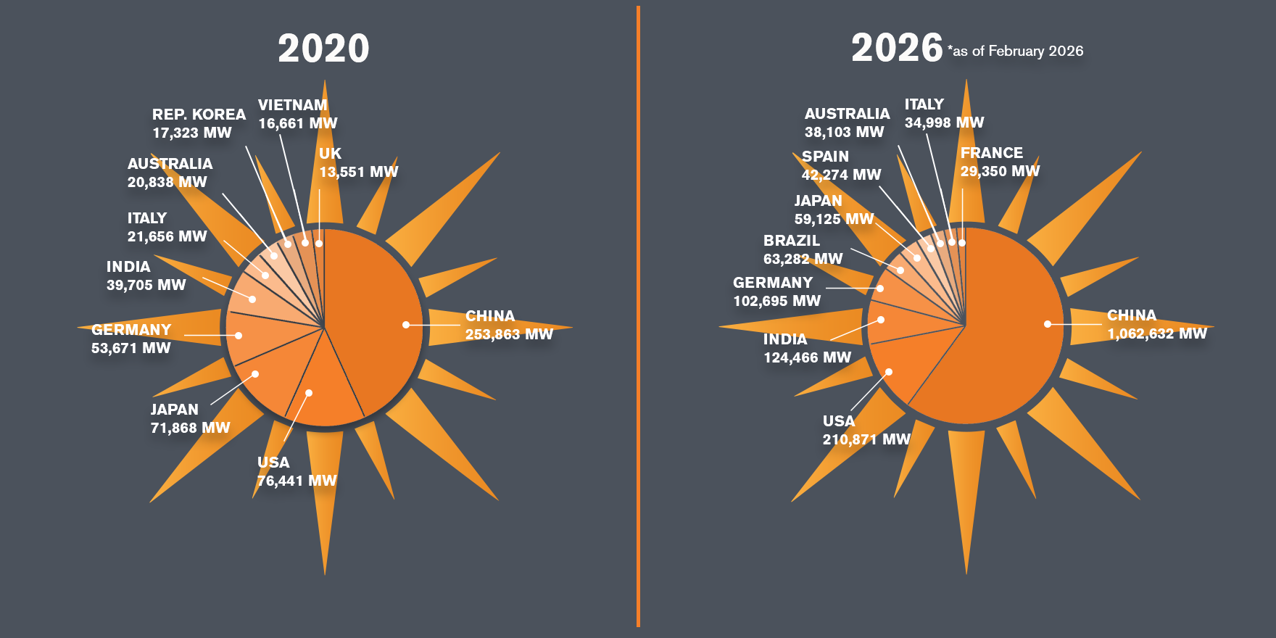
China led the world in 2025 with 1,062,632.1 MW of total operating solar capacity, preserving a year-on-year lead. The strategic edge is not only scale, but geography: desert megabases in Inner Mongolia and other western regions are being paired with major transmission buildouts to move power eastward. By the end of 2024, China had already exceeded 880,000 MW of utility-scale solar and had more than 720,000 MW of projects in development, reinforcing its unmatched depth.
2) United States
The United States followed with 210,871.3 MW of total operating solar capacity, reflecting a market that continues to scale across utility, commercial and distributed segments. Solar accounted for 54% of all new U.S. electricity-generating capacity additions, confirming its central role in new-build supply. Texas and the wider Sun Belt power that expansion through strong solar resources, abundant land, large utility-scale project pipelines and fast-growing solar-plus-storage deployment, helping utilities add capacity quickly and support rising electricity demand.
3) India
India’s solar market is shifting from ambition to execution at truly national scale. In 2025, it reached 124,465.73 MW of total operating solar capacity, confirming its place among the world’s fastest-scaling major markets. Installed capacity had already climbed to 110,900 MW by June 2025, with strong additions across utility-scale, rooftop and distributed segments. That breadth matters because India is using solar not only for decarbonisation, but also for energy security, industrial policy and supply expansion as electricity demand rises sharply across the economy. This also reflects the country’s steady advancement towards the target of achieving 500 GW of non-fossil fuel-based capacity by 2030.
4) Germany
Germany remains one of Europe’s benchmark solar markets, combining sustained deployment with growing generation across a highly industrialised power system.
It stood at 102,694.68 MW of total operating solar capacity, reinforcing solar’s place at the core of the national electricity mix. Photovoltaics also moved ahead of lignite in public electricity generation, illustrating how rooftop uptake, utility-scale buildouts, batteries and self-consumption are working together at scale. The broader significance is structural: Germany offers a strong example of how solar can deepen energy security, strengthen supply and integrate effectively across a complex grid.
5) Brazil
Brazil has emerged as Latin America’s leading solar market, combining exceptional solar resources with strong growth in both utility-scale projects and distributed generation. It reached 63,281.76 MW of total operating solar capacity, underscoring its position as one of the world’s most dynamic solar economies. Distributed solar has been the fastest-growing power source in the country, while large-scale plants continue to expand Brazil’s fleet and broaden solar’s role in the electricity mix.
That combination gives the market depth across households, businesses and grid-scale supply, strengthening energy diversification and widening the reach of solar across the country.
6) Japan
Japan remains one of the world’s most established solar markets, with growth now centred more on distributed applications and technology innovation than on land-intensive expansion. It held 59,124.86 MW of total operating solar capacity, underscoring solar’s continued role in the national power system and its long-term energy strategy. With land at a premium, the market is advancing through rooftops, commercial self-consumption and agrivoltaics, while policy support is also accelerating next-generation solutions such as perovskite cells. That combination keeps solar strategically important to Japan’s future electricity mix, especially as deployment broadens across buildings, businesses and local energy uses.
7) Spain
Spain has become one of Europe’s most influential solar markets, pairing large-scale deployment with a steadily rising contribution to national electricity supply. It reached 42,273.6 MW of total operating solar capacity, reinforcing its place among the continent’s strongest solar performers. Solar photovoltaic capacity moved ahead of wind early in the year, and photovoltaics supplied 18.4% of Spain’s electricity over the full year. That progress shows how quickly solar has moved from expansion alone to a central role in the power mix, with the next phase focused on integrating more capacity efficiently through storage and grid development.
8) Australia
Australia stands out as a solar market where household adoption is as strategically important as utility-scale development. In 2025, it recorded 38,103.03 MW of total operating solar capacity, while cumulative photovoltaic capacity moved beyond 45,000 MW across the broader market. Rooftop solar alone reached 28,300 MW and supplied 14.2% of electricity in the second half of the year. That consumer-led base is strategically important as it reduces daytime grid demand, encourages battery adoption and shows how high-solar electricity systems can operate with increasing flexibility and resilience.
9) Italy
Italy has developed into a more diversified solar market, with growth increasingly anchored in commercial and industrial installations alongside larger grid-scale plants. In 2025, it reached 34,988.16 MW of total operating solar capacity, underlining solar’s expanding role in the national power system. Solar generation also climbed to a record 44.3 TWh, driven by a combination of additional installed capacity and stronger solar irradiation, with photovoltaic output rising 25.1% year on year. The market’s structure is increasingly defined by commercial and industrial demand, larger projects and self-consumption, reflecting solar’s expanding role in Italy’s electricity system.
10) France
France rounds out the top ten with 29,350.45 MW of total operating solar capacity, underlining its importance in the European market. It added a record 5,900 MW of solar during the year, with around 65% of that volume coming from the 100–500 kW segment, led by businesses, farmers and local authorities. Solar generation also increased significantly thanks to stronger sunshine and a larger solar fleet. Together, those trends show a market expanding through a broader base of commercially and institutionally driven deployment, giving solar a more prominent and systemically important role in France’s electricity mix.
Solar Energy Prospects
The rapid build-out of solar capacity across these markets highlights how decisive policy frameworks, sustained investment and ongoing technological progress are shaping the global energy transition. Together, these factors are enabling solar to play a larger role in national power systems and wider decarbonisation strategies. As more countries strengthen their focus on renewables, solar is set to remain central to delivering cleaner electricity, improving energy security and supporting a more resilient and sustainable long-term energy mix.
Our Role in Solar Energy
At Eland Cables, we understand the critical importance of robust infrastructure in supporting the global solar energy boom. Our range of solar cables, designed for durability, safety and efficiency, play a crucial role in the installation and maintenance of solar power systems worldwide. Whether for commercial or grid-scale solar projects, Eland Cables offers the expertise and products to meet the demands of this growing industry. We are proud to support this green revolution by providing essential components that ensure seamless integration and reliable performance of solar power systems. At the forefront of this transition, we deliver industry leading products and solutions for efficient power transmission.
Together, we can power a sustainable future.