BS7671 Amendment 4 - An Overview
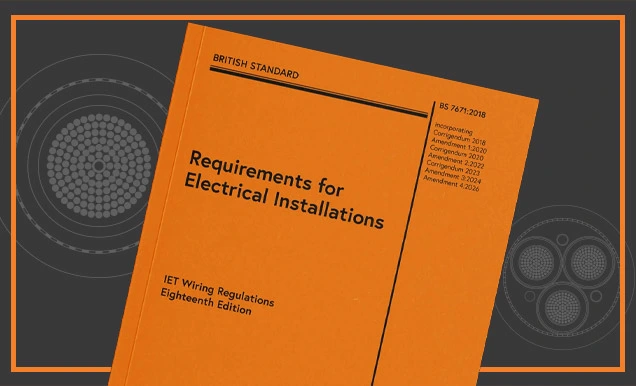
The IET and BSI have confirmed the publication of Amendment 4 to BS 7671:2018, introducing key changes to the Wiring Regulations that will shape electrical installations from 2026 onwards. Published on 15 April 2026, the amendment takes effect immediately, with Amendment 3:2024 withdrawn on 15 October 2026.
The update reflects the accelerating adoption of renewable energy, battery storage and digital infrastructure, while placing a stronger emphasis on electrical fire safety and system resilience. Several of the new provisions extend both the scope and depth of installation requirements, with practical implications across design, product selection, and compliance.
What did Amendment 3:2024 introduce?
Amendment 3:2024 to BS 7671 focused on strengthening protection against fire, electric shock and electrical faults, particularly in domestic and similar installations. Key updates included an expanded emphasis on Arc Fault Detection Devices (AFDDs), refinements to requirements for surge protection devices (SPDs), and clarifications around RCD selection and coordination.
The amendment also supported the growing use of low‑carbon technologies by building on earlier requirements for EV charging equipment, prosumer installations and renewable energy systems.
Key changes introduced by Amendment 4
Stationary Secondary Batteries (New Chapter 57)
Chapter 57 introduces dedicated requirements for stationary secondary battery systems, reflecting their rapid and widespread adoption across modern electrical installations. This chapter sets out requirements for the design, selection and installation of battery energy storage systems (BESS), recognising their growing use alongside PV installations, EV charging infrastructure and onsite energy storage. The regulations address key safety considerations associated with high‑energy systems, including fire risk management, ventilation and protection against electrical and thermal hazards.
Specific attention is given to installation location, with guidance that limits or discourages battery installations in roof spaces, where fire detection, containment and emergency intervention can be more challenging. Requirements also cover means of isolation, protection against overcurrent and short‑circuit faults, and the control of thermal effects during both normal operation and fault conditions. Ventilation provisions are included to prevent the accumulation of heat or gases, depending on battery technology. The chapter adopts a risk‑based approach, allowing system design to account for factors such as battery chemistry, enclosure type and proximity to occupied areas, while establishing a consistent baseline for electrical and fire safety.
Power over Ethernet (PoE) (Section 716)
Section 716 sets out requirements for Power over Ethernet (PoE) installations where data cables are used to carry extra-low voltage DC at relatively high power levels in addition to data signals. The regulations recognise that higher PoE power classes can lead to increased temperature rise within cables, particularly where multiple cables are grouped or installed in enclosed containment systems. As a result, the section places emphasis on current‑carrying capacity, derating and installation conditions, ensuring that cables are not operated beyond their thermal limits. Protection against mechanical damage is also addressed, by applying the general wiring-system principles of BS7671 to PoE cabling. The requirements aim to ensure that PoE systems are designed and installed with the same level of thermal and safety as traditional power circuits, while acknowledging their unique characteristics. Section 716 reinforces the need for coordination between electrical and ICT design to maintain safety, performance and reliability.
Functional Earthing and Bonding (Section 545)
Section 545 includes specific requirements for functional earthing and functional equipotential bonding, particularly for ICT systems, smart technologies and data‑driven equipment. The regulations distinguish functional earthing, which supports system performance and electromagnetic compatibility, from protective earthing, which is intended primarily for safety against electric shock. This distinction helps reduced unwanted interference without compromising protective measures or fauly protection. The section provides guidance on when functional earthing is required, how it should be connected, and how it should be coordinated with the overall earthing arrangement of the installation. Functional equipotential bonding is emphasised as a means of reducing electromagnetic disturbance across interconnected equipment. These requirements reflect the growing complexity of modern installations, where reliable operation depends not only on safety measures but also on signal stability, noise reduction and system interoperability across multiple technologies.
Medical Locations (Section 710)
Section 710 contains updated requirements for electrical installations in medical locations, where continuity of supply and fault protection are critical to patient safety particularly in Group 1 and Group 2 locations. The regulations reinforce the role of supplementary protective equipotential bonding in reducing touch voltages under fault conditions, particularly in patient environments. A key update is the introduction of new schedules for recording the measured resistance of supplementary bonding connections, supporting consistent verification and traceability of test results throughout the life of the installation. These records form part of the ongoing inspection and testing regime, ensuring that safety measures remain effective after commissioning. The section continues to differentiate requirements based on the medical location classification, including Group 1 and Group 2 areas, and aligns bonding, earthing and protective measures with the operational risks present. Overall, the updates strengthen procedural clarity and support a lifecycle approach to electrical safety in healthcare environments.
Energy Efficiency (Chapter 81)
Chapter 81 introduces a structured framework for considering energy efficiency in low‑voltage electrical installations, extending the scope of electrical design beyond safety and functionality. Rather than mandating specific technologies, the chapter focuses on assessment and informed decision‑making, encouraging designers and operators to evaluate energy losses and efficiency opportunities within an installation. This includes consideration of conductor losses, equipment selection and operational practices. The framework can be applied to new installations, extensions or significant alterations, allowing energy efficiency to be considered proportionately and in line with project objectives. This chapter aligns electrical installation practice with wider sustainability and decarbonisation goals, supporting improved transparency around energy performance. By embedding energy efficiency into the regulatory structure, the chapter formalises its role as a core design consideration alongside protection, reliability and compliance.
Amendment 4: the impact
Amendment 4 reflects a wider shift towards electrification, digitalisation and decentralised energy, increasing the need for careful product selection where fire performance, thermal behaviour and reliability are critical. This is particularly relevant for installations involving energy storage, PoE and higher‑risk environments.
These changes also sit alongside the Construction Products Regulation, reinforcing the importance of ensuring that products used in fixed electrical installations are appropriately classified, documented and verified as projects move towards their 2026 compliance timelines.
Copies of BS7671 Amendment 4 can be purchased from the IET website.