Small Rodents, Big Delays: The Hidden Threat to Railway Networks

When assessing risks to critical infrastructure, cyber threats, extreme weather, and system failures are often top of mind. And yet, one of the most frequent and underestimated threats is wildlife.
Across global power networks, animal interference is a well-known cause of outages.
Examples of the havoc animals can cause to power grids are not in short supply. In Kenya, a single monkey managed to bring down the entire country’s power grid. In 2013, the world’s largest boiling-water nuclear reactor, Oskarshamn on the Baltic Sea in Sweden, was forced to shut down due to jellyfish clogging the cooling water intake. In 2017 in the US, a squirrel caused a fire and city-wide power outage in Luverne, Minnesota by chewing on cables.
To give you an idea of the full breadth of the problem, Cyber Squirrel is a website that maps incidences of animal interference, and since 2013 they have reported 1,850 “attacks”. While the site is quite amusing, the issue is far from a laughing matter.
Within the rail sector, however, the risk is more specific—and more persistent. Rodent damage to rail infrastructure can cause signalling faults, cable failures, and ultimately, train delays.
From Wildlife Disruption to Rodent Damage in Rail
While large-scale wildlife incidents can disrupt power grids, railway networks are more commonly affected by smaller animals—particularly rodents.
Rats and squirrels constantly gnaw to control their teeth growth. Unfortunately, railway cables and signalling systems provide an ideal target, especially in trackside and underground installations.
Over time, this behaviour can damage cable insulation, expose conductors, and result in system failures that directly impact network performance.
How Rodent Damage to Rail Causes Train Delays
Modern railways depend on reliable signalling, power, and communication systems—all of which rely on high-performance cabling.
Common impacts of rodents’ destructive behaviour include:
- Signalling failures leading to speed restrictions or service stoppages
- Power supply issues affecting sections of track
- Train delays and cancellations across the network
- Increased maintenance and repair costs for operators
Even minor instances of rodent damage to railway cables can create cascading delays, affecting both passenger and freight services.
Why Railway Cable Systems Are Vulnerable
Railway infrastructure relies on extensive networks of cables installed in environments that are inherently exposed:
- Trackside routes
- Underground ducts
- Remote or difficult-to-access locations
These conditions make it challenging to monitor and protect assets, while also creating ideal habitats for rodents.
Preventing Rodent Damage to Rail with Engineered Cable Solutions
Addressing rodent-related failures requires a proactive, engineered approach. Our Cable Lab® experts took on the challenge to reduce rodent issues for one of our rail clients. They needed a rodent resistant cable that still kept its flexibility. Alternate sheathing materials were considered, such as steel wire braiding, but ultimately it was found that a layer of fibre glass tape was successful in discouraging the animals. While rats still gnaw on the cable, their gums are cut by the tape which deters them from chewing the cable to break point.
Proven Performance with The Cable Lab®
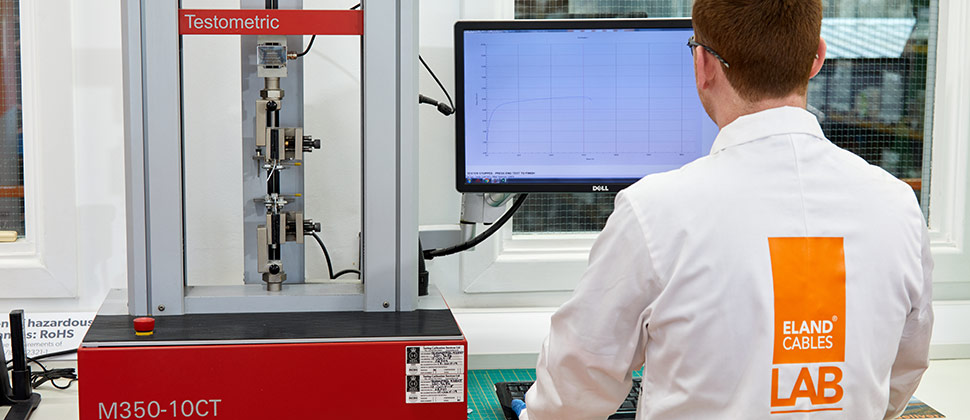
All Eland cable solutions are validated through The Cable Lab®, our in-house UKAS-accredited testing facility.
Our experts performed extensive testing to demonstrate the performance of the rodent resistant cable; this was then submitted alongside all the requisite paperwork necessary for product approval.
Our portfolio today includes solutions such as:
These cables are engineered to deliver both performance and protection, reducing the risk of damage in operational environments.
This evidence-based approach ensures that solutions are not only compliant but proven to reduce the risk of rodent damage to rail cables.
Reducing Delays and Improving Reliability
While wildlife remains an unavoidable part of the environment – and rodent damage a real threat – its impact on infrastructure can be mitigated.
With the right cable solutions in place, operators can protect their networks from one of the most persistent hidden threats.
Need help choosing the right cable?
Our sales team will be happy to discuss your requirements with you. Contact us today.