A league of their own: The infrastructure behind major sporting events
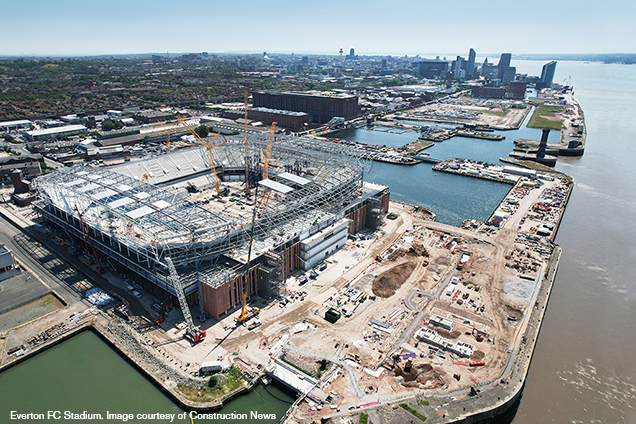
There’s always a buzz when it comes to major sporting events, but what does it take in order to host such events? Whether it’s an international football competition such as the FIFA World Cup, the NFL Superbowl, or even the Olympic Games, hosting major sporting events requires a combination of permanent venues, city-wide infrastructure, and "overlay"—temporary structures and services designed to transform spaces into event-ready hubs.
What is a temporary event "Overlay"?
Because most existing facilities do not meet the highly specific demands of global events, a massive array of temporary infrastructure is usually required to increase capacity and manage crowds.
This infrastructure can include:
Structures: modular hospitality suites, tents, and demountable temporary seating.
In preparation for the FIFA 2026 World Cup existing stadiums currently used for NFL games have had structural changes made to seating areas; VIP boxes and lower seating rows were removed or temporarily dismantled to meet FIFA-required dimensions, safety zones and media areas.
Facilities: mobile sanitary systems (toilets/showers), medical stations, and food/beverage concessions.
Access & Security: gated access control, secure perimeter and route fencing, ticketing systems, and VIP/media zone demarcation.
New security systems have been introduced in the stadiums used for the World Cup 2026, entry control systems have been modernised, ticketing technologies upgraded and Wi-Fi and digital infrastructure expanded. In many venues, this marked the first large-scale integration of digital systems into stadium operations.
Digital & broadcast connectivity
Mega-events rely heavily on high-speed internet, telephony, and broadcast capability.
In Spain and Portugal, countries hosting the FIFA 2030 World Cup alongside Morocco, hotels located near host stadiums are investing in high-tech infrastructure. This includes fully integrated, immersive 360-degree event spaces, hospitality lounges, and specialised broadcast areas for media and corporate sponsors.
Broadcasting: dedicated cables and temporary communication overlays to support global streaming feeds, both for television and digital.
FIFA have set guidelines for broadcasting and media, stating stadiums should be designed with an appropriate level of infrastructure for the matches they host, including dedicated external space for broadcast vehicles needing to connect to the in-stadium infrastructure. For major matches, the space required will extend up to approximately 2,000m². Cable routes between the broadcast compound and the stadium should be carefully designed to ensure crossover with spectator and vehicle routes is avoided or, as a minimum, controlled.
Connectivity: secure, scalable networks for stadium operations, media personnel, and high-capacity wireless internet for spectators.
BT is the official telecommunications partner for the UEFA European Championship 2028. The company is implementing record-breaking fibre networks, 5G+ systems, and bespoke in-stadium tech across all nine venues to handle the expected extraordinary data and broadcast demands.
City-wide & public infrastructure
Beside each venue, the host city must update its infrastructure's capacity to handle a massive influx of tourists, athletes, and staff. For example:
Transport & Transit: expansion or optimisation of public transit, airports, structured ingress/egress routes, and dedicated production vehicle lanes.
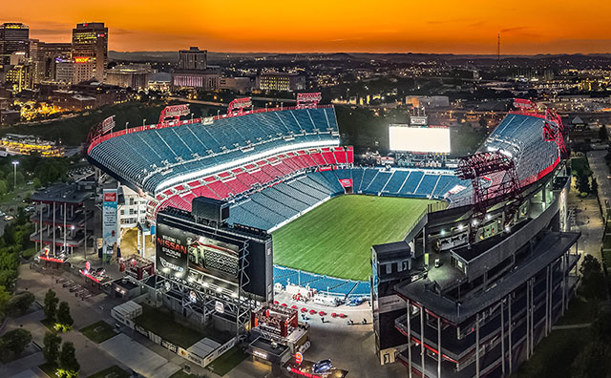
In Nashville, ahead of the Superbowl in 2030, the surrounding area of the new $2.2 billion Nissan Stadium is receiving $300 million in new public infrastructure, including a new pedestrian bridge which will play a key part in easing transportation challenges as it will provide a direct, walkable route to the venue.
Nashville International Airport (BNA) is undergoing a $3 billion "New Horizon" expansion that features two new concourses, central core renovations, and improved roadways, with completion set for 2029.
In EMEA the government of Morocco plans to invest MAD12.5 billion (US$1.3 billion) into highway infrastructure projects ahead of the 2030 FIFA World Cup, which the country is jointly hosting with Spain and Portugal.
Accommodation: accommodation facilities, athlete villages, and media housing to handle the temporary population increase.
Nashville’s metro area is projected to feature more than 80,000 hotel rooms across 658 properties by 2030, with thousands of rooms already added in the downtown core since 2020.
Hotel capacity has been identified as a critical regional bottleneck in Morocco ahead of the 2030 FIFA World Cup, with the Moroccan government launching a $4 billion investment strategy, including aims to add 25,000 new hotel rooms, boosting the Kingdom’s total hotel capacity by roughly 20%. This supports Morocco's long-term goal of drawing 26 million annual tourists by 2030.
Modern Winter Olympic infrastructure integrates deeply into host communities. For example in the recent 2026 Winter Olympics, areas like Milan’s Porta Romana were converted into a sustainable, mixed-use neighbourhood and student housing, rather than building new temporary housing.
Operations & sustainability
Modern sporting events—as dictated by the International Olympic Committee's (IOC) frameworks like Olympic Agenda 2020+5—require hosts to prioritise long-term sustainability to avoid "white elephant" facilities (empty, unused stadiums). The factors to consider are:
Energy & Power: massive deployment of temporary generators, power distribution networks, and lighting.
The Estadio Azteca (Mexico City) has gone through a major overhaul ready for the World Cup 2026, bringing capacity to 90,000 and installing 2,000 square meters of exterior LED screens
Legacy Planning: designing infrastructure that can be easily removed, repurposed for the community, or scaled down post-event.
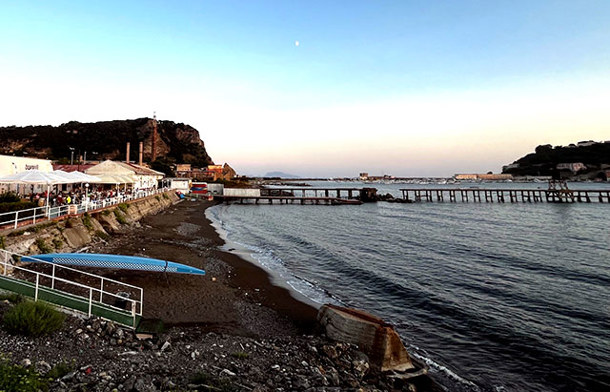
In Naples, improvements to prepare the city to host the 2027 America’s Cup are underway, following a long-term strategy to contribute to the regeneration efforts of the Bagnoli area. The development includes a 35-hectare permanent Sports Park, metro railway extension to meet transport needs and a €180M cleanup of the contaminated industrial waterfront, seen below (as the site was formally one of Italy’s largest steel plants).
In the King Abdullah Financial District in Riyadh, Saudia Arabia a custom, open-air temporary venue was built specifically for the WWE Royal Rumble 2026. The venue was erected in under 35 days, bypassing the need for a permanent stadium.
London 2012 is remembered as a model of urban redevelopment. The former industrial area of Stratford, in the east of the city, was transformed into a modern Olympic Park, featuring new sports facilities, green spaces, infrastructure, and housing. After the London Olympics, the area became a vibrant and sustainable new neighbourhood.
What happens to infrastructure after major sporting events?
After a major sporting event, infrastructure often follows one of two paths: it either becomes a vital, repurposed community asset (like housing or civic buildings) or decays into costly "white elephants" burdened by heavy debt and maintenance. The long-term outcome largely depends on how well the facilities are planned for post-event use.