
How should electrical cable drums be handled / shipped?
Electrical cable drums can be heavy, difficult to move and vulnerable to damage if they are handled incorrectly. Before handling, lifting, rolling or transporting a cable drum, complete a suitable risk assessment and use equipment rated for the drum weight and cable load.
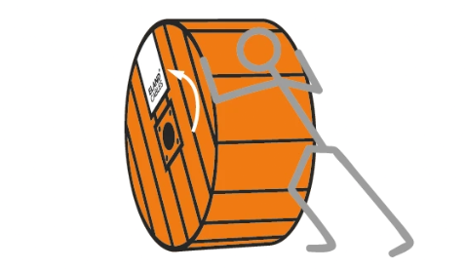
Cable drums should be kept upright wherever possible and protected from impact, rolling, tipping or crushing. Plywood drums should not be rolled on the ground, and wooden cable drums should not be rolled over long distances
Can cable drums be rolled?
Cable drums should only be rolled for short distances when there is no safer mechanical alternative. Before rolling a drum, check:
- The mass of the drum
- The visibility in the direction in which the drum is being rolled
- The condition of the ground (which should be smooth, hard and flat)
- The method of rolling and the direction of lay of the cable on the drum
- The condition of the drum
- Any additional considerations flagged by the risk assessment
Handling drums
Wooden drums usually have an arrow marked on their flanges to indicate the direction in which the cable should be wound onto them as well as the direction in which the drum should be rolled. Particular care should be taken with full drums of cable.
How should cable drums be lifted?
Particular care should be taken with full cable drums. Use suitable lifting equipment rated for the load and avoid any method that places pressure on the cable, drum flange or protective covering.
When lifting cable drums with a crane, support the drum with a through shaft and spreader bar to prevent damage to the drum and cable.
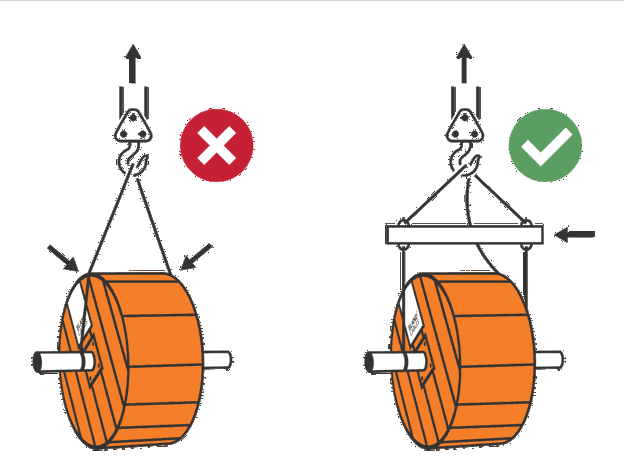
When using a forklift truck to lift the cable, the drum must be handled correctly, lifting from the right direction. The cable should never be lifted by the flange on the flat and must be lifted on its edge as shown below;

How should cable drums be transported?
When shipping or transporting electrical cable drums, make sure each drum is secured to the vehicle and adequately strapped or wedged to prevent movement, rolling or tipping in transit. Drums should be positioned and supported so that the cable is not crushed, loosened or damaged during loading, transport or unloading.
For more detailed information on handling cable drums, download our pdf guide.
People also ask

Cable drums come in many different sizes and weights depending somewhat on the materials they are made of. Read more about drum sizes, materials and weights...
Cable size selection is based on 3 main factors: Current carrying capacity, Voltage regulation, Short circuit rating. Read more about the cable sizes and what determinate them...
There are many different environmental and operational conditions which are likely to influence the longevity of electrical cables in service. Read more about these factors and the experts' estimation on cables' life expectancy...

Cable Portfolio
View our comprehensive range of power, data, control and instrumentation cables and accessories
Go
